
The U.S. government is taking legal action against Southern California Edison, seeking reimbursement for the costs of battling two major wildfires allegedly caused by the utility’s equipment. One of the fires, known as the Eaton Fire, erupted in January in Los Angeles County, claiming 19 lives and destroying thousands of homes and buildings.
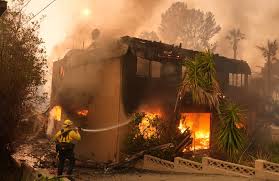
Federal prosecutors filed lawsuits on Thursday in a Los Angeles federal court, asking that Southern California Edison be held financially responsible for wildfire suppression and land restoration efforts related to both the Eaton Fire and the Fairview Fire, which burned through areas east of Los Angeles in September 2022 and resulted in two deaths.
The lawsuits claim that both fires were caused by negligence in the operation, maintenance, or use of the company’s power lines and related infrastructure.
As wildfires have become more frequent and destructive in the western U.S., largely driven by climate change, utilities like Southern California Edison have faced growing liability. A similar situation led to PG&E’s bankruptcy after the 2018 Camp Fire. To help cover losses, California established wildfire relief funds, but those resources are now at risk of running dry following recent large-scale fires in Los Angeles.
Southern California Edison, which operates as a subsidiary of Edison International, is already the subject of numerous lawsuits connected to the Eaton Fire. Many of those claims argue that the fire was sparked by the utility’s equipment. While the exact cause of the blaze is still being investigated, early findings point to utility involvement in the fire that ravaged the Altadena area.
The Fairview Fire, which started in 2022, burned approximately 28,000 acres, according to CalFire records.
Southern California Edison has not yet issued a statement in response to the federal government’s lawsuits.
According to court documents, the government alleges the Eaton Fire began due to sparks or failure from defective power equipment owned and operated by Southern California Edison. The utility, the complaint notes, was aware of the increased risk of wildfires during high-wind conditions but failed to act. It cited a company press release issued the day before the fire, warning of “extreme winds and possible outages,” as evidence that the risk was known.
The lawsuits state that Edison operates three transmission lines in Eaton Canyon, the suspected ignition point. The company also reportedly admitted that it had detected a “fault” on one of its lines near the time the fire began.
The federal government is asking the court to compel Edison to cover the full cost of suppressing the Eaton Fire and restoring over 8,000 acres of damaged National Forest land—a cost estimated at over $40 million. The lawsuits also seek repayment for the firefighting and rehabilitation expenses related to the Fairview Fire, which affected around 14,000 acres.
In addition to the Eaton Fire, another blaze—driven by the same strong winds—broke out in Pacific Palisades in January, scorching more than 20,000 acres.
The cases are listed as U.S. v. Southern California Edison, case numbers 25-cv-8356 and 25-cv-8357, filed in the U.S. District Court for the Central District of California.